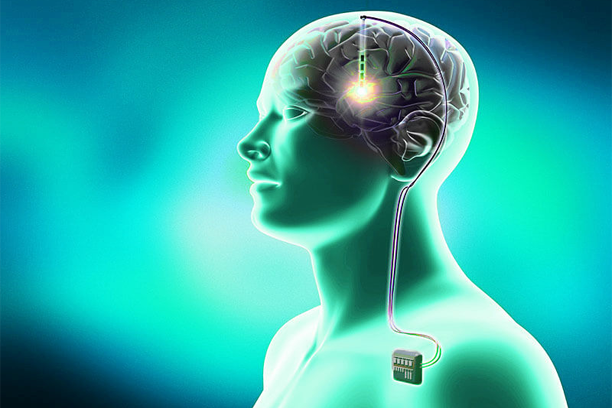
Deep brain stimulation is a neurosurgical procedure which can be done for treatment of various movement disorders such as Parkinson’s disease, dystonia, essential tremors and Tourette syndrome as well as some other disorders of brain. It involves the implantation of a neurostimulator (a brain pacemaker) in the chest area beneath skin which sends electrical energy in pulses through extension wires to implanted electrodes in the specific regions of brain such as subthalamic nucleus, globus pallidus interna and thalamus.
Deep Brain Stimulation for Parkinson’s disease
Parkinson’s disease is a degenerative disease of the brain. Tremors at rest, stiffness of body, slowness of all daily activities and imbalance while walking are cardinal symptoms of Parkinson’s disease. With the progression of disease, the response of medications wane off gradually and patients develop motor fluctuations in form of medications related OFF period and dyskinesia (abnormal involuntary dance like movements of body) during drug ON time. Deep brain stimulation can be considered at this stage of Parkinson’s disease as these fluctuations are generally refractory to oral medications and respond well to surgery. All cardinal symptoms mentioned above respond well to DBS. The usual areas of target of DBS for Parkinson’s disease are subthalamic nucleus (STN) and globus pallidus interna (GPi).
Steps for DBS surgery:
- Preoperative evaluation:
Before surgery, a dedicated movement disorders specialist evaluates the patient in detail for his symptoms and conducts a oral levodopa challenge test. A comprehensive neuropsychological assessment by a neuropsychologist is also necessary before surgery.
- Intraoperative:
The DBS surgery is done in two phases. In the first phase, electrodes are implanted in the brain under stereotactic guidance, during which patient remains awake. While, in the second phase of surgery, implantable pulse generator (IPG) battery or pacemaker is implanted in the chest, which is connected to brain electrodes via extension wires.
- Postoperative:
One to two weeks after surgery, the movement disorders specialist switches on the IPG battery and does programming of the same. The optimal settings require few days to weeks.
Deep brain stimulation for dystonia
Dystonia is defined as any abnormal twisting movement or posture or both of any body part, which can be continuous or intermittent. The usual brain target of DBS surgery for dystonia is globus pallidus interna (GPi). It is usually performed in cases of segmental or generalized dystonia. Dystonia usually takes longer time to resolve after the surgery and IPG battery programming.
Deep brain stimulation for essential tremor
Essential tremor is one of the commonest cause of tremors. It can be familial or non-familial. It usually occurs in both hands while doing activities with hands such as holding a glass or cup of tea, shaving etc. However, it can also occur in other body parts such as head, tongue, voice or jaw. Surgical therapies are usually considered in essential tremor when symptoms are not adequately controlled with maximally tolerated dose of oral medications. The usual brain target of DBS surgery for essential tremor is Ventral Intermediate Nucleus (VIM) of the thalamus.